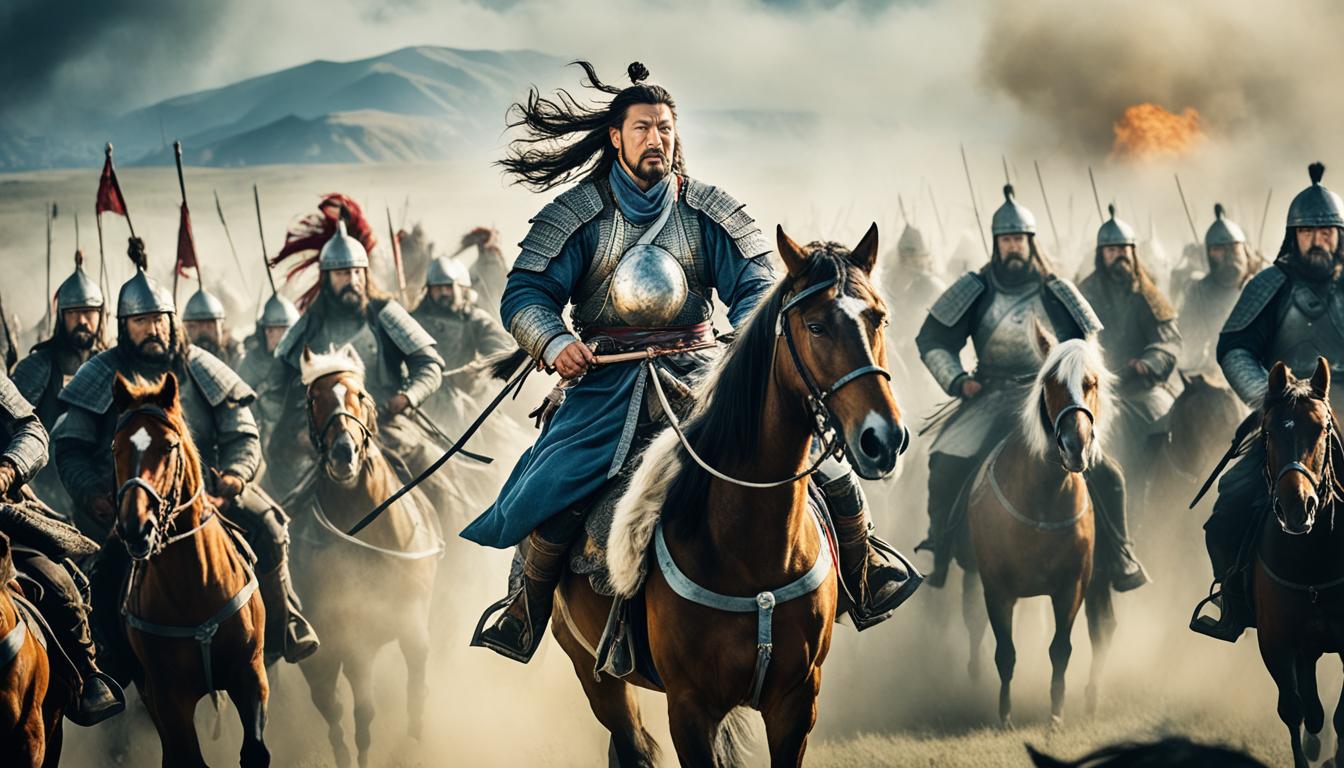
Genghis Khan, born Temujin, was a legendary Mongol ruler. He united the nomadic tribes of Northeast Asia. He founded the Mongol Empire, the largest contiguous land empire in history.
His military campaigns and strategic innovations changed world history. He conquered vast territories from Eastern Europe to the Sea of Japan. This section will explore the remarkable life and lasting legacy of Genghis Khan, a key figure in world history.
Temujin, later known as Genghis Khan, was born around 1162 in the Khentii Mountains of modern-day Mongolia. Despite starting from humble beginnings, he became one of the most powerful rulers in history. His leadership, strategy, and determination helped him unite the Mongol tribes.
He established the Mongol Empire, which stretched from Eastern Europe to the Sea of Japan. Genghis Khan’s legacy as a world conqueror and military genius has lasted for centuries. His strategic innovations and tactical brilliance have shaped Eurasian history.
His impact on Asian history and the Mongol Ruler’s lasting influence are still studied and admired by scholars and history enthusiasts.
Humble Beginnings: The Early Years of Genghis Khan
Genghis Khan, also known as Temujin, was born around 1162 CE in Mongolia. His childhood was tough, marked by hardship. He was a minor chieftain’s son from the Borjigin clan, a Mongol tribe. These early struggles shaped his ambition to lead the Mongol tribes.
Temujin’s father, Yesugei, was killed when Temujin was just a boy. This left the family poor and at risk. Temujin and his siblings had to survive on their own, learning the hard truths of life early. This tough start made him determined to succeed and lead.
From Temujin to Genghis Khan: A Name that Shook the World
Temujin grew up and started to lead among the Mongol tribes. He formed alliances and built his power. He then took the title of “Genghis Khan,” meaning “Universal Ruler” in Mongol. This name change showed his shift from a struggling young man to the powerful Genghis Khan.
Genghis Khan’s early life and struggles shaped his character. They drove him to unite the Mongol tribes under him. His rise and new title led to his military successes and the Mongol Empire. His legacy still inspires people worldwide.
Rise to Power: Uniting the Mongol Tribes
Genghis Khan’s journey to power was amazing. He used his charm and diplomacy to bring the Mongol tribes together. He started by rallying the Borjigin clan and others, overcoming their differences.
He won battles, made smart deals, and led with great skill. This helped him unite the Mongols into a strong empire. His military tactics and tribal alliances made the Mongols a force to be reckoned with.
Genghis Khan faced tough challenges, like rival leaders and tribal politics. But he was determined and adaptable. His military skills helped him beat these challenges and become the top Mongol leader.
Genghis Khan proved his strategic mind by uniting the Mongols. He used their strength and shared goals to create a powerful empire. This empire would later conquer much of the known world.
The Mongol Conquest: A Ruthless Military Campaign
Genghis Khan’s military campaigns were known for their fierce and smart tactics. He used new strategies to quickly take over huge areas from the Caspian Sea to the Sea of Japan. His military skills were a big reason why the Mongols expanded so fast across Eurasia.
Tactics and Strategies that Shaped Genghis Khan’s Victories
The Mongol army’s success came from its fast cavalry, well-planned attacks, and strong communication. Genghis Khan’s troops were known for their discipline and toughness. They were very good at adapting and were harsh to those who didn’t give in easily.
They were great at gathering information and using it to their advantage. This helped them catch their enemies off guard and win battles quickly. Their speed and strength in attack were unmatched.
Genghis Khan aimed to keep growing his empire and strengthen his power. He was very good at changing his plans based on the land and his enemies. His military campaigns showed great strength and strategy, changing Eurasian history forever.

Genghis Khan: The Ruler and Administrator
Genghis Khan is known for his military skills, but he was also a great ruler and administrator. He created a strong system of governance for the Mongol Empire. This made it the largest empire in history.
Governing the Largest Contiguous Empire in History
Genghis Khan had a detailed legal code called the “Yassa.” It supported religious freedom, boosted trade, and helped manage the empire well. His leadership showed his great planning and vision.
Under Genghis Khan, the Mongol Empire had a time of peace and growth called the “Pax Mongolica.” This period helped trade, sharing goods and ideas, and allowed people to move freely. The Mongols’ good governance and laws were key to this success.
Genghis Khan was more than a military leader. He was skilled in administration and governance. His central system, the Yassa, and the Pax Mongolica period helped manage the vast empire. This made him a visionary ruler.
The Legacy of Genghis Khan: Lasting Impact on History
Genghis Khan’s impact on world history is huge. His military wins and political legacy changed human civilization forever. The Mongol Empire spread ideas, technologies, and cultures far and wide.
This led to new innovations in architecture, medicine, and trade. Genghis Khan’s legacy shows in the growth of Eurasia’s politics, society, and economy. The Mongol Empire brought together many people under one rule.
This led to sharing of cultures and knowledge. Such sharing changed the course of history for many societies. It shaped the future of the world.
Genghis Khan is seen as a key figure in history. His military skills, strategic mind, and leadership helped build the Mongol Empire. It was the biggest empire in history at its peak.
The Mongols brought new military tactics, ways to communicate, and systems of governance. These changes helped spread technology and culture far and wide.
Today, Genghis Khan’s legacy is still studied and admired. Scholars look into how the Mongol Empire changed the world. From Samarkand’s architecture to advances in medicine and trade, the Mongols left a mark on history.
This shows the lasting effect of one of history’s most influential leaders.
History: The Mongol Empire’s Influence on Trade and Civilization
The Mongol Empire, led by Genghis Khan, changed the world’s history. It made a big impact on trade and cultural exchange across Eurasia. By securing the Silk Road, the Mongols helped move goods, ideas, and technologies between East and West. This helped advance civilizations in the region.
This time of sharing knowledge and economic growth is known as the “Pax Mongolica.” The Mongols’ wide reach and stability let merchants, scholars, and craftsmen move freely along the Silk Road. This led to a big exchange of knowledge and new ideas. The Mongols introduced things like gunpowder, the Mongol script, and paper currency, changing trade and civilization.

The Mongols controlled the Silk Road, which meant more than just moving goods. It also spread cultural, technological, and scientific advancements. This exchange of ideas between East and West led to the Renaissance and the age of exploration. The Mongols also had a big economic impact, creating a trading network and new currencies that helped connect different economies and bring prosperity.
The Mongol Empire’s lasting effect on trade and civilization shows what strong leadership and embracing cultural exchange can do. The Mongols united vast territories, starting a time of global connection. We still feel the effects of this today.
Genghis Khan: Myths and Legends Surrounding the Conqueror
Genghis Khan’s life and legacy have been filled with myths and legends. These stories have grown over time, showing our deep interest in this legendary figure. Tales of his magical birth and his military skills have amazed people for centuries.
Separating Fact from Fiction in the Life of Genghis Khan
It’s hard to know what’s true about Genghis Khan because of his legendary status. By looking at historical evidence, we can learn more about his life and achievements. Some myths might be based on truth, while others are just stories people made up to honor Genghis Khan.
One famous myth is that Genghis Khan was born with a sign of greatness, a blood clot in his hand. But history tells us he was born to a minor chieftain, not a divine being.
Stories about his military skills and genius have grown over time. He was indeed a great military leader who expanded the Mongol Empire. But his success also came from his army’s strength, discipline, and smart tactics.
Looking into the myths and legends about Genghis Khan helps us understand his lasting impact on history. His story still inspires and fascinates us as we try to separate fact from fiction.
The Descendants of Genghis Khan: A Lineage of Rulers
Genghis Khan, the legendary Mongol leader, left a lasting legacy. His family took over a vast empire after he died. Sons and grandsons like Ögedai, Jochi, and Kublai Khan built on his success. They changed the course of Eurasian history.
The Borjigin clan, Genghis Khan’s family, ruled the Mongol Empire. His descendants, also known as the Borjigin clan, started several Mongol dynasties. The Yuan Dynasty under Kublai Khan was one of them. They kept the Mongol Empire strong as it grew.
Kublai Khan, Genghis Khan’s grandson, is famous among his descendants. He started the Yuan Dynasty and expanded the empire into China. His capital was in present-day Beijing. The Yuan Dynasty under Kublai Khan had a big impact on politics, economy, and culture.
Expanding the Mongol Empire and passing it down was hard for Genghis Khan’s family. Conflicts broke out among his sons, causing power struggles. But the Borjigin rulers kept the Mongol Empire strong for many years.
Genghis Khan’s family changed the Mongol Empire and the world. Their leadership, military skills, and administration helped the empire grow and last. This made the Borjigin clan famous in history as a line of powerful rulers.
The Fall of the Mongol Empire: Decline and Fragmentation
The Mongol Empire was once a powerful force across Eurasia. It faced a decline and fragmentation that was hard to stop. This was due to many factors like internal conflicts, economic issues, and outside threats.
Factors Contributing to the Collapse of Genghis Khan’s Empire
As the empire grew, keeping it together became harder. Genghis Khan’s family fought over power, causing problems. The empire’s size made it hard to manage taxes, trade, and resources well.
Outside forces also hurt the Mongol Empire. The Mamluk Sultanate and the Ming Dynasty in China got stronger. They were better at fighting the Mongols. The Mongols faced too many challenges, leading to the empire breaking apart.